


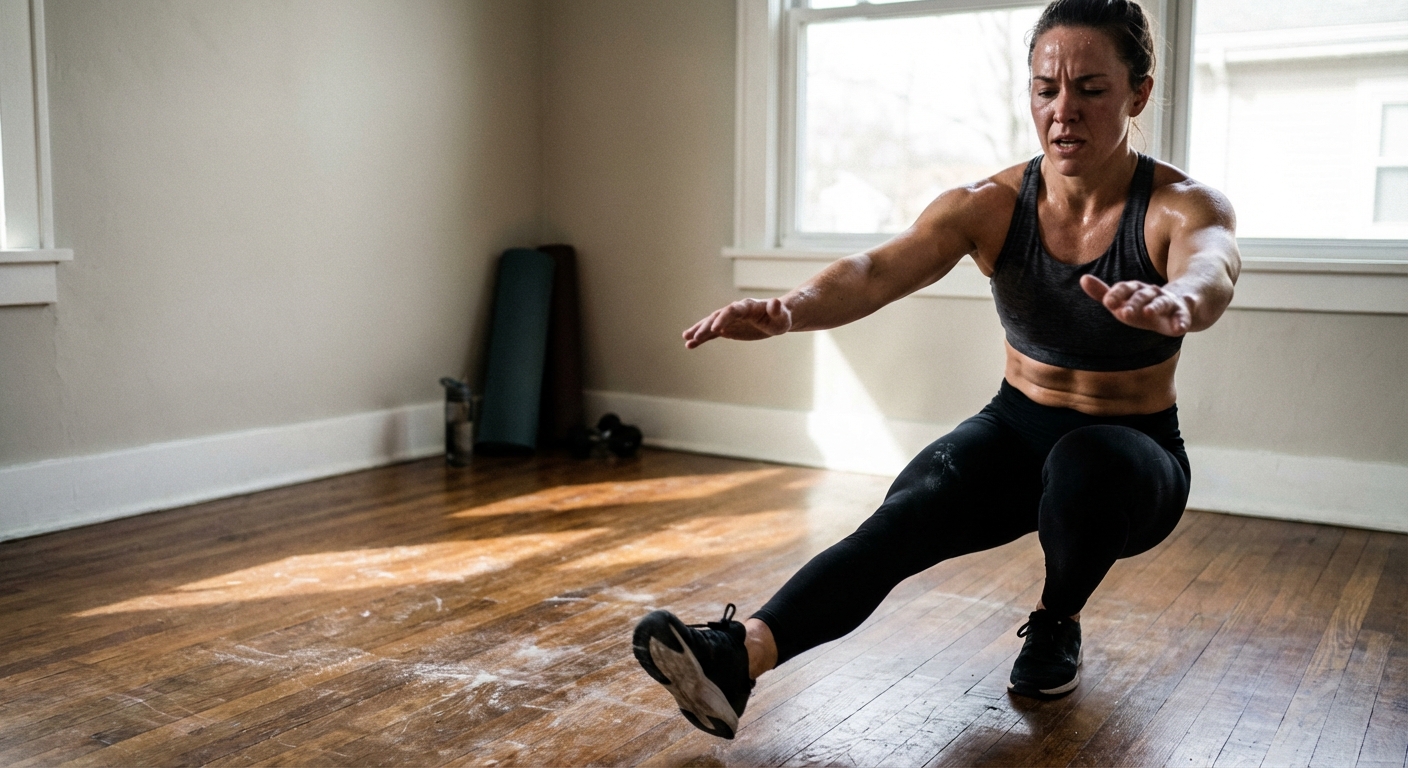
Body-weight squats are the ultimate no-excuse investment in lifelong strength, longevity, and pain-free movement, and this guide shows you exactly how to master them at home. You’ll learn why every rep bulletproofs knees, boosts aerobic capacity by a third, and slashes mortality risk while making daily tasks—standing from a chair, chasing kids, climbing stairs—feel effortless. The article breaks down rock-solid form fundamentals, joint-saving warm-ups, and five game-changing variations—from power-building jump squats and balance-sharpening skater squats to single-leg pistol and shrimp squats, hip-opening sumo squats, and leg-blaster Bulgarian split squats—so you can progress safely without equipment. Clear, science-backed cues help you avoid common mistakes, track smart weekly cycles, and apply progressive overload so you keep adding reps, depth, or tougher moves long after the newbie gains fade. Whether you’re after fat-burn, athletic speed, or the independence to move strongly as you age, these variations deliver a scalable roadmap from first body-weight rep to elite single-leg strength, all in the living-room space between couch and coffee table.
Bodyweight Squat Variations at Home: Why They Matter
Bodyweight squats are your joint-protecting, longevity-boosting ticket to moving through life stronger—because every rep turns your own body into a gym that makes groceries, kids, and stairs feel effortless while cutting your risk of dying early.
Functional strength built through bodyweight moves
Here's the truth about bodyweight squats: they're your secret weapon for building real-world strength that shows up everywhere. While gym machines have you moving in one direction, squats fire up multiple muscle groups at once—just like life demands [1]. Think about it—every time you stand from a chair, pick up groceries, or chase after kids, you're using the exact same muscles: quads, hamstrings, glutes, calves, core, and lower back [2][3]. That's functional fitness in action.
The science backs this up in a big way. Research published in Circulation found that people with stronger legs literally live longer—those with powerful quads had lower mortality rates over six years [3]. But here's what really matters for your daily life: bodyweight squats transform how you move, breathe, and feel. After just 10 weeks of bodyweight training, participants saw their aerobic capacity jump by 33% and core endurance climb by 11% [1].
No equipment, no excuses—just you getting stronger and more capable every single day. Your body becomes your gym, and movements like squats become the foundation for everything else.
Mobility and joint health benefits
Let's bust a myth right now: squats aren't bad for your knees—they're actually your joint's best friend. Every rep sends fluid through your knee, hip, and ankle joints while building the protective muscle around them [4]. Physical therapists know the truth: when done right, squats bulletproof your knees instead of breaking them down [5]. That stronger support system means fewer injuries both in and out of the gym—because stronger legs equal safer movement, period [5].
But here's where it gets really exciting. Regular squatting unlocks mobility that makes everything easier. Getting out of bed, playing on the floor with kids, grabbing that thing you dropped—it all becomes effortless when you've built this foundation [6]. The beauty of bodyweight training?
You can start exactly where you are and gradually expand your range of motion through different squat variations. For those devoted to staying active and independent as they age, squats deliver something priceless: protection against falls and the freedom to move without limits [5]. As we'll explore in the safety section later, proper form is key—but once you've got it, the versatility of squat variations helps you fight back against the stiffness that comes from too much sitting [6].
Preparing Your Body for Effective Squat Sessions
Master the fundamentals—hips back, knees tracking, thighs parallel—and fire up with dynamic warm-ups that can boost your squat performance by 79% while shielding you from injury.
Master the basic squat form first
Ready to build a foundation that'll carry you through every squat variation? Let's nail the basics first—because great squats start with great form. Plant your feet shoulder-width apart with toes turned slightly outward (15-30 degrees), distributing your weight evenly [7]. Here's the key: initiate the movement by pushing your hips back like you're reaching for a chair behind you—not by bending your knees first [9].
Keep that chest proud, shoulders back, and core engaged throughout the movement [9]. Your knees should track over your toes without caving inward—this protects your joints and maximizes your power [8]. Watch out for these common mistakes: heels lifting off the ground, chest dropping forward, or cutting your depth short [8]. Aim to lower until your thighs reach parallel to the floor or deeper if your mobility allows [7].
Remember to breathe naturally—holding your breath makes everything harder than it needs to be [8]. If depth is challenging right now, grab onto something sturdy for support while you build that mobility [7]. Master these fundamentals before advancing—solid technique compounds your success with every variation [9].
Dynamic warm‑up routine for leg readiness
Here's something powerful: a proper warm-up can boost your performance by up to 79% while keeping you injury-free [10]. Forget static stretching—dynamic movements are your secret weapon, warming muscles through controlled motion that fires up your core temperature and unlocks joint mobility [11]. Start strong with 5-10 minutes of light cardio like brisk walking or easy cycling to get that blood flowing [10]. This wakes up your nervous system and primes your body for what's coming. Once you're warm, flow into full-body dynamic stretches like cat-cow and downward dog—these movements prepare your entire posterior chain for action [10].
Now let's get specific. Fire up those squat muscles with spiderman lunges (add thoracic rotation for extra hip mobility), walking lunges to activate your quads, and glute bridge abductors to wake up your powerhouse muscles [10]. Don't forget ankle mobility—it's often what holds people back from hitting proper depth. Add targeted ankle exercises to unlock your range of motion [12]. The downward-dog to cobra flow is pure gold for your hamstrings and lower back [10].
Build your warm-up like this: general cardio first, then full-body movements, followed by targeted leg work, and finish with bodyweight squats to groove that pattern [12]. Take your time—5-10 reps of each movement without rushing [10]. This 10-15 minute investment pays massive dividends in performance and protection [11]. Want expert guidance through every movement?
Safety checks to protect your joints
Your joints are precious—let's keep them healthy for life. Start with alignment: knees should track over your toes throughout every rep, never caving inward (this puts serious stress on your knee joint) [13]. Keep your weight balanced through your heels and midfoot—shifting forward onto your toes cranks up knee stress and throws off your balance [14]. Here's the truth about depth: deeper isn't always better. Forcing range of motion beyond your current mobility causes that dreaded "butt wink" (pelvis tucking under), which hammers your lower back [14].
Work within your body's current abilities—you'll build depth naturally over time. Want a reality check? Film yourself from front and side angles. You'll be amazed how different your actual form looks compared to how it feels [13]. And always listen to your body—sharp pain (not muscle burn) is your signal to adjust or modify [14].
Smart prep is joint protection. Target those common tight spots—ankles, hips, and upper back—with focused mobility work (covered in detail above). When these areas are tight, your body compensates in ways that stress your knees and back [15]. Remember: mastering movement quality always beats chasing difficulty or depth [14].
5 Must‑Try Bodyweight Squat Variations
Explode into jump squats, master single-leg skater squats, and conquer pistol or shrimp squats to torch calories, bulletproof your balance, and erase sneaky strength imbalances that regular squats miss.
Explosive power: Jump Squat and Skater Squat
Ready to level up your squats? Jump squats are where power meets performance! This explosive variation supercharges your regular squat, helping you move faster and react quicker—whether you're sprinting after the bus or playing weekend sports [16]. Plus, they torch calories while building the ankle and hip flexibility that keeps you injury-free [18]. Here's how to nail them: Drop into your squat stance (remember that perfect form from earlier?
), sink down deep, then explode upward like you're reaching for the stars. Swing those arms forward for extra lift, land soft as a cat, and flow straight into your next rep [16]. Trust us—you'll feel unstoppable after just a few sets! Now let's talk skater squats—your secret weapon for bulletproof balance! This single-leg powerhouse builds the kind of stability that transfers directly to running, jumping, and those quick direction changes in sports.
What makes skater squats special? That free leg positioned behind you creates a more upright position that fires up your glutes while protecting your back [17]. Whether you're dodging defenders on the field or navigating crowded sidewalks, this move builds the real-world stability that keeps you strong and injury-free [17]. The best part? It addresses those sneaky muscle imbalances we all develop from favoring one side.
Single‑leg mastery: Pistol Squat and Shrimp Squat
Time to get serious with single-leg mastery! These challenging moves expose and fix the strength imbalances regular squats miss. Pistol squats—where you extend one leg forward while squatting on the other—are the ultimate test of strength and control. Your weight shifts back to your heel, firing up those glutes while your core works overtime to keep that extended leg floating [19][20]. Shrimp squats flip the script by having you hold your back leg behind you. This shifts the work to your quads and creates a whole different balance challenge [19]. Think of it this way: pistols challenge you not to tip forward, while shrimps test your ability to stay upright when pulled backward [20]. Both will humble you—and then make you stronger than ever!
New to single-leg work? Start with shrimp squats—they're more forgiving for beginners [19]. Try the hands-free version first: balance on one leg with arms out front, bend your back leg behind you, and lower until that knee kisses the ground [21]. Once you own this move, level up by grabbing your back foot for an extra balance challenge and quad stretch [21]. For pistol squats, start smart with a bench behind you. Lower onto it first, then work toward the full range of motion [20]. And here's some good news: don't stress about your knees going past your toes. Science says it's totally safe when you control the movement [19].
Track your progress with the Each variation demands different mobility (check Section 3 for specific mobility work). Pistol squats need serious ankle flexibility and hip strength to keep that front leg floating [20]. Shrimp squats ask more from your hamstrings and hip flexibility as you hold that back leg up [21]. Choose based on your goals: runners and cyclists, go for shrimp squats to power up those glutes. Basketball players and jumpers? Pistol squats will build the quad strength you need for explosive moves [20]. Either way, you're building the kind of real-world strength that makes life easier—from bounding up stairs to staying steady on uneven ground [21].
Depth and stability: Bulgarian Split Squat and Sumo Squat
Bulgarian split squats are the ultimate leg builder—no weights required! Elevate that back foot on a bench and watch your front leg light up. This position forces one leg to do all the heavy lifting, firing up your quads, glutes, hamstrings, and core harder than regular squats [22]. What makes these special? They expose those strength differences between your legs that regular squats hide, while building the stability that transfers directly to running and sports [23]. Plus, you get all the benefits of weighted lunges using just your bodyweight [23]. Set up 2-4 feet from a bench, prop that back foot up, and sink down until your front thigh hits parallel.
Keep that knee tracking straight (remember the alignment tips from Section 2) [24]. Feel the burn? That's your legs getting stronger! Sumo squats prove that sometimes wider is better! This powerhouse variation lights up your inner thighs and glutes just by changing your stance. Step wide—about 3-4 feet—and turn those toes out at 45 degrees [22]. This wider stance is a game-changer if regular squats feel uncomfortable.
You can sink deeper with less forward lean, making it perfect when hip mobility isn't your strong suit [24]. As you push your hips back and drop down, you'll feel muscles working that regular squats miss [22]. The magic happens when your knees track out over your toes and you hit that parallel position—your hips naturally open up, taking pressure off your lower back [24]. It's like your body was designed for this movement. Plus, every rep improves your hip and ankle mobility for all your other exercises!
Progression, Tracking, and Staying Strong Forever
By strategically cycling heavy, explosive, and high-volume squat days while tracking every rep, depth, and rest day, you’ll keep your legs growing stronger for life without ever needing a gym.
Designing a weekly leg workout plan
Ready to turn your squat game into a lifelong strength journey? Creating a smart weekly plan is where the magic happens. Start with three squat-focused sessions weekly if you're just beginning—this gives your muscles time to adapt while keeping you hungry for more [26]. As your strength builds, level up to 4 sessions weekly, mixing in those variations you've mastered [25].
For the truly devoted? You can crush legs 5-6 times weekly by being strategic—alternate heavy strength days (think 8-12 reps of those challenging pistol squats), explosive speed days (jump squats with minimal rest), and higher-volume days with easier variations [25][26]. This proven approach builds unstoppable lower body strength without any equipment. Here's your winning week: Monday brings heavy squats, Tuesday shifts to upper body, Wednesday fires up dynamic movements, Thursday is recovery gold, Friday combines full-body work with moderate squats, and weekends are for active recovery or well-earned rest [25].
The key to continuous gains? Progressive overload—add reps each week, advance to harder variations, or slow that lowering phase to 3-4 seconds for an extra burn [26]. Never stack two intense leg days back-to-back—your muscles grow during recovery, not just training. Space those challenging sessions with rest or upper-body work to come back stronger every time [25].
Tracking reps, range, and progress
What separates random workouts from real results? Tracking your progress like the devoted athlete you are. Start simple—count those reps! Begin with 2-3 sets of 12-20 repetitions, letting perfect form be your guide [27]. As you get stronger, stay in that sweet spot of 6-20 reps for maximum muscle growth (though some devoted souls push the range from 4 all the way to 40 reps!
) [29]. But tracking goes beyond counting. Monitor your squat depth and alignment—as we covered in the safety section, filming yourself reveals what you can't feel in the moment [29]. Keep notes on both the hard data (reps crushed, depth achieved) and how you feel (difficulty level, any discomfort). This awareness accelerates your progress.
Your path to continuous gains follows these trackable milestones: push reps toward 20 per set, slow that descent to a challenging 3-4 seconds, shorten rest periods, or level up to more demanding variations [29]. Here's your progression signal—when you nail 8 solid reps of any variation, you're ready for the next challenge [28]. This systematic approach turns those frustrating plateaus into launching pads for your next breakthrough. Track it, own it, and watch your strength soar beyond what you thought possible.
Stronger legs correlate with lower mortality over six-year studies.
Body-weight squats boost aerobic capacity 33% and core endurance 11% in 10 weeks.
Dynamic warm-ups raise performance 79% and cut injury risk.
Knees tracking over toes protects joints; caving inward stresses them.
Explosive jump squats build power and ankle-hip mobility.
Single-leg pistol/shrimp squats expose and fix side-to-side imbalances.
Progress when you hit 8 solid reps of a variation, then advance or add tempo.