


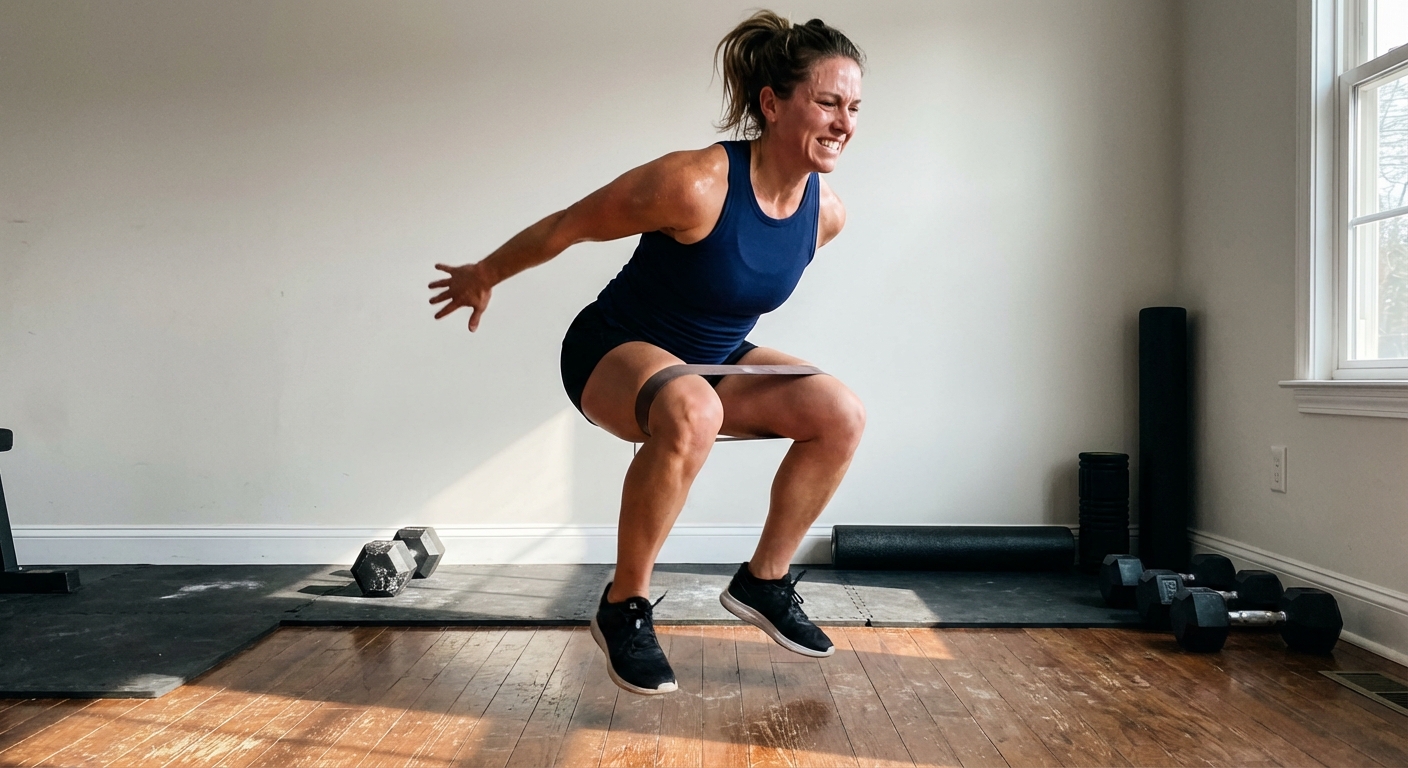
This article delivers a complete blueprint for transforming your legs at home using only resistance bands, guiding you from warm-up to recovery through eight explosive moves that build real athletic power. You’ll discover how to fire up dormant hip stabilizers and glutes with mini-band activation drills, then unleash explosive strength through band-resisted squat jumps that can boost vertical leap by 21 % in eight weeks while slashing 5 K times. The program balances power with injury-proofing: lateral walks sculpt bulletproof hips, reverse-band lunges forge single-leg strength that carries over to running and jumping, and targeted isolation work—standing leg curls, hip thrusts, and calf raises—fills weak links for balanced, head-to-toe development. Each exercise exploits variable band tension to challenge muscles hardest where they’re strongest, and the article packs pro tips on resistance selection, tempo, and progression so you keep gaining without gear or gym. Finish with the recommended static and band-assisted mobility flows to cement flexibility, cut soreness, and unlock tight hip flexors from sitting. Whether you want speed, muscle definition, or joint-friendly conditioning, this concise system proves a simple band is your ticket to stronger, more explosive legs anywhere.
Warm‑Up & Activation for Maximum Band Power
Fire up your legs like Chris Hemsworth prepping for action: grab a mini-band, hit 45-60 seconds each of lateral walks, fire hydrants and glute bridges to wake up sleepy hip stabilizers and glutes with tension that grows stronger the farther you stretch.
Dynamic Mobility Drills to Prime Your Legs
Ready to unleash your leg power? Start with 5-10 minutes of dynamic mobility work that gets your blood pumping and your muscles firing – just like Chris Hemsworth preps for his high-intensity action scenes! Grab your resistance band and begin with lateral walks, stepping sideways with the band just above your knees to wake up those hip stabilizers and glutes [3].
Next, add some excitement with ankle jumping jacks – they're like regular jumping jacks but with that extra band resistance to really engage your inner and outer thighs [3]. Here's where it gets interesting: these movements create variable resistance – meaning the tension increases as you stretch the band, giving your muscles a unique challenge throughout their full range of motion [2]. That's exactly why bands are such powerful tools for building strength!
Perform each drill for 45-60 seconds or 10-15 repetitions per side, focusing on quality over speed. Your legs are about to thank you for this proper warm-up!
Band‑Specific Activation: Mini‑Band Glute Warm‑Up
Now it's time to wake up those glutes – the powerhouse muscles that drive explosive movement! Mini-bands are your secret weapon here, creating constant tension that activates those smaller stabilizing muscles we often forget about [4]. Trust us, your glutes will be singing after this targeted activation sequence. Start strong with fire hydrants – get on all fours with a band above your knees, then lift one knee outward without shifting your hips.
This fires up your gluteus medius and minimus like nothing else [4]. Next, flip onto your back for glute bridges, driving your knees outward against the band while lifting your hips high [4]. Feel that burn? That's strength being built!
Side-lying clamshells are next – keep that band above your knees and open your top knee while your feet stay together [4]. For an extra challenge, try banded squat preps to light up multiple muscle groups at once – the band gives instant feedback to keep your form on point [5]. Finish with tabletop kickbacks, looping the band around your arches and extending one leg behind you [4]. These aren't just random moves – they're strategically priming your neuromuscular system for the explosive work ahead.
Core Explosive Moves to Build Leg Strength
Explode through band-resisted squat jumps—8 weeks of 3–4 sets of 6–8 max-power reps can cut 5K time by 3.6% and spike vertical leap 21.4%, far outpacing weighted squats.
Band Squat Jumps – Power From the Ground Up
Ready to unleash explosive leg power? Band squat jumps are your secret weapon for building the kind of strength that translates to real athletic performance. Position a resistance band just above your knees or loop it under your feet with the ends secured at shoulder level. Here's where it gets exciting – as you explode upward, the band creates increasing tension right when your muscles would normally coast, forcing you to power through the entire movement [6]. This matches exactly how your muscles are designed to work, challenging you most when you're strongest [6]. The results speak for themselves – band-resisted squat jumps can slash your 5K times by 3.
6% while boosting your muscle force generation by 8% and reactive strength by an impressive 15. 7% [7]. Even better? After just 8 weeks, you'll see nearly double the vertical jump improvements compared to traditional weighted squats (21. 4% vs 12. 9%) [8].
That's the kind of explosive power that makes a real difference in your performance. To maximize your gains, choose bands that give you about 30-35% resistance at the top of your jump with minimal tension at the bottom [8]. Here's your game plan: 3-4 sets of 6-8 explosive reps with full recovery between sets. Quality beats quantity every time – focus on maximum power with each jump rather than rushing through [6]. Land with athletic control by softly absorbing the impact through your hips and knees [6].
Lateral Band Walks with Pulse for Hip Stability
Time to build bulletproof hip stability with lateral band walks. These target your often-overlooked gluteus medius and hip abductors – the unsung heroes that keep you injury-free and performing at your peak [10]. Loop a resistance band just above your knees, drop into an athletic stance, and take controlled steps sideways while keeping constant tension [9]. Want to level up? Add a pulse – a mini-squat between each step that'll light up those glutes like never before.
Stay low throughout the movement with a neutral spine, keeping your feet between hip and shoulder-width apart [9]. This move doesn't just sculpt your outer thighs – it's your foundation for rock-solid knee stability and the kind of balance that makes every athletic movement feel effortless [10]. The payoff? Better posture through proper pelvis alignment and a lower back that thanks you every day [10]. Aim for 10-12 steps each direction or keep moving for 30-60 seconds straight [9].
As you get stronger, level up with thicker bands [10]. Remember those fire hydrants and clamshells from your warm-up? They're the perfect complement to lateral walks, creating a complete hip stability routine that attacks every angle [9].
Reverse Band Lunges with Controlled Eccentric
Reverse band lunges are where single-leg strength meets explosive power – and your joints will love you for it. Unlike forward lunges that can stress your knees, reverse lunges keep most weight on your stable front leg – making them perfect for building strength safely [11]. Anchor a band at hip height, loop it around your hips, and feel how it guides you into perfect form with every rep [12]. Here's where the magic happens – control your descent until your front thigh is parallel to the floor, knee at 90 degrees, with your back knee hovering just above the ground [12].
This slow, controlled lowering phase is your secret weapon for awakening those fast-twitch muscle fibers that create explosive power [13]. The band acts like your personal form coach – if you feel slack, you know you're out of position [11]. Drive through your front heel (not your toes) to fire up those glutes and hamstrings while giving your quads a break [11]. This movement mirrors real-world athleticism better than standard squats, translating directly to improved running, jumping, and sport performance [13].
Plus, working one leg at a time fires up those crucial hip stabilizers, building the kind of balanced strength that keeps you injury-free [13]. Breathe with purpose – inhale as you lower, brace that core like you mean it, then exhale with power as you drive back to standing [12]. Start with 10 reps per leg for 3-4 sets, and once your form is dialed in, challenge yourself with thicker bands or added weight. Remember, perfect form beats heavy resistance every time.
Targeted Isolation for Balanced Development
Anchor a band and curl your heel to glute—owning that peak-tension squeeze for 3–4 sets of 10–15 reps per leg—locks in stronger, balanced hamstrings that power everything from stairs to deadlifts.
Standing Band Leg Curls for Hamstring Control
Time to show your hamstrings some love! Standing band leg curls are your secret weapon for building strong, balanced legs that power you through life. The beauty of bands? They create increasing tension right when your hamstrings are working hardest – at the top of the movement [14]. Here's how to nail it: Anchor your band at ankle height and loop it around one ankle.
Stand facing the anchor, grab something sturdy for balance, then curl your foot toward your glute while keeping that thigh perfectly still [15]. Stay tall, keep your core fired up, and resist the urge to arch your back [14]. You're targeting all three hamstring muscles – that's serious posterior chain power! Focus on controlling the weight down – that's where the magic happens for muscle growth [15]. Common mistakes to dodge?
Going too heavy too fast, cutting your range of motion short, or letting your knee drift around [15]. Start with 3-4 sets of 10-15 reps per leg [14], and watch how stronger hamstrings transform everything from climbing stairs to crushing your workouts [16]. This move pairs perfectly with the hip-hinge exercises in your [Centr strength program](https://centr. com/p/strength), creating the balanced development inspired by Chris Hemsworth's own training philosophy.
Band Hip Thrusts & Glute Bridges for Posterior Power
Ready to build serious posterior power? Hip thrusts and glute bridges are absolute game-changers for your glutes and hamstrings. Science backs this up big time – these moves light up your glutes like few others can, delivering what researchers call "very high activation" right up there with deadlifts [17]. Want to maximize your results? Here's the insider knowledge: Point your feet out about 30 degrees instead of keeping them straight – this simple tweak fires up your glutes even more [17].
Loop a band around your thighs to activate those smaller stabilizer muscles that often get ignored [18]. Pro tip: Use smaller weight plates so you can achieve full hip extension without the plates hitting the floor [18]. The best part? You don't need massive weights to see results. Even using just 40% of your max weight delivers incredible glute activation [17], making this perfect whether you're just starting out or you've been training for years.
Level up your game with this killer variation: Place sliders under your feet during glute bridges. This forces your hamstrings to work overtime as they fight to keep your feet from sliding away [18]. It's the kind of challenge that builds real strength – no momentum, just pure muscle control. This is exactly the type of functional posterior chain development that creates athletic power from the ground up.
Band‑Assisted Calf Raises for Explosive Push‑Off
Don't sleep on your calves! Band-assisted calf raises build the explosive push-off power that makes you faster, more agile, and ready for anything. Your calves are the unsung heroes of athletic movement – the gastrocnemius powers your explosive movements while the soleus keeps your ankles rock-solid [19]. Here's your setup: Stand shoulder-width apart, loop that band under your feet, and hold the ends at shoulder level. Now drive through your toes and rise up onto the balls of your feet [19].
The key? Control that descent – take it slow on the way down to protect your Achilles and maximize every rep [19]. Want to take it up a notch? Find a step or platform and let your heels drop below parallel before each rep. This deeper stretch wakes up more muscle fibers and builds the elastic power that translates to real-world speed [19][20].
The band's variable resistance is pure gold here – it peaks right when your calves are fully contracted, delivering results bodyweight alone can't match [19]. Progress like a pro: Master two-legged raises first, then challenge yourself with single-leg work. Add that elevated surface when you're ready, and finally dial up the band resistance [19]. Strong calves equal longer strides and faster turnover – exactly what you need to move like an athlete in everything you do [20]. This is the kind of functional strength that powers you through life, inspired by the comprehensive training approach that keeps Chris Hemsworth camera-ready year-round.
Cool‑Down & Recovery to Cement Gains
Lock in your leg-day gains by spending 30–60 seconds in each of these band-assisted static stretches—quad, hamstring, figure-four, wide-fold—while your muscles are still warm, slashing soreness, rebalancing joints, and cutting future injury risk in half.
Static Stretching Routine for Quads & Hamstrings
Static stretching after band-intensive leg work prevents muscle imbalances and reduces post-workout soreness. Unlike warm-up dynamic movements, these longer-held stretches require fully warmed muscles for optimal benefit [23]. For quadriceps, the standing quad stretch targets muscles fatigued from explosive band exercises - stand tall, grab one ankle, and pull gently toward your glutes while maintaining balance [22]. Hold each position for 30 seconds while breathing deeply, allowing muscles to release further with each exhale [23].
The supine hamstring stretch effectively targets posterior leg muscles without lower back strain - lie on your back, loop a resistance band around your raised foot, and gently pull the leg closer while maintaining a neutral spine [21]. This position creates a safe stretch that's particularly effective after intensive band work that has shortened hamstring tissue [21]. For deeper hip and hamstring release, incorporate the figure-four stretch by lying on your back, crossing one ankle over the opposite thigh, then drawing the bottom leg toward your chest [21]. This addresses both hamstrings and glutes while releasing the piriformis muscle that often contributes to posterior chain tightness [21].
The seated hamstring stretch targets both hamstrings and calves simultaneously - sit with one leg extended and the other foot against your inner thigh, then hinge forward from the hips while maintaining a flat back [23]. Complete your routine with the standing wide-leg forward fold to comprehensively address multiple muscle groups stressed during resistance band training [23]. Research shows optimal stretching duration is 30-60 seconds per position, with consistent post-workout stretching potentially reducing injury risk by maintaining muscle length and joint mobility [21].
Band‑Assisted Mobility Flow for Hip Flexors
Band-assisted mobility flows unlock hip flexors by combining continuous movement with variable resistance. This sequence targets the iliacus, psoas major, psoas minor, and rectus femoris—the primary muscles that flex your hip and knee joints [1]. Start with banded standing hip flexor stretches by looping a band around a sturdy anchor point at ankle height, placing your other foot through the band, then stepping back until you feel tension across the front of your hip [24]. From this position, flow into banded leg raises—maintaining the band's tension while lifting your knee toward your chest, then extending your leg backward without locking your knee [25].
Next, transition to banded lateral hip openers by stepping sideways while maintaining tension, which activates both hip flexors and surrounding stabilizers [1]. For deeper mobility, incorporate banded fire hydrants by positioning the band above your knees while on hands and knees, then lifting each knee outward against resistance while maintaining a neutral spine [25]. The constant tension from resistance bands provides immediate feedback about your movement patterns and creates variable resistance through the entire range of motion [1]. Unlike static stretching, this flowing sequence enhances both flexibility and strength simultaneously, addressing the common imbalance of tight, weak hip flexors from prolonged sitting [24].
For optimal results, move slowly through each position for 30-45 seconds per side, focusing on breath coordination and core engagement rather than repetitions [25]. This mobility flow not only improves hip function but transfers directly to better posture, reduced lower back pain, and improved athletic performance by restoring proper pelvic alignment [24].
Band squat jumps boost vertical leap 21% vs 13% with weights in 8 weeks.
Reverse lunges with band hip anchor build single-leg power while sparing knees.
Standing band curls peak tension at hamstring top for maximum muscle growth.
Glute bridges with 40% max load and 30° foot flare yield very high activation.
30-60s static stretches post-workout cut injury risk by preserving muscle length.