


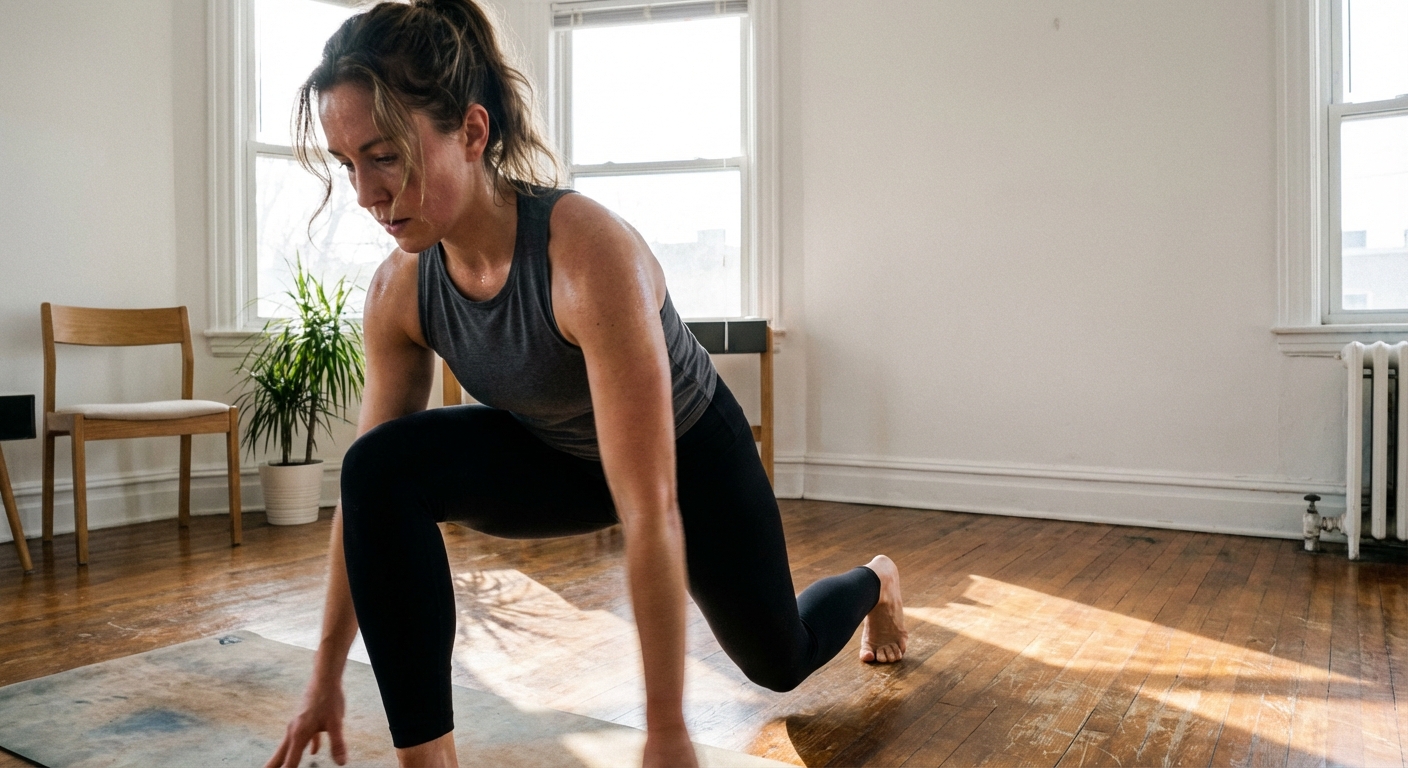
Mastering body-weight lunge variations at home is the fastest, equipment-free route to stronger, sculpted, injury-proof legs, and this guide hands you every tool you need—from perfecting the basic forward lunge with knee-safe alignment and rock-solid core engagement to exploiting dozens of progressions such as joint-friendly reverse lunges, inner-thigh-targeting lateral and curtsy moves, balance-crushing walking and overhead versions, and muscle-quaking isometric holds and pulses. You’ll learn how to fix the most common form flaws (short strides, wobbling knees, torso collapse) and scale from beginner assistance moves all the way to elite single-leg pistol squats using smart “bottoms-up” and box-assisted tactics. The article maps out weekly programming templates (three to six sessions, 2–5 sets, 8–20 reps) that layer variations for continuous strength gains while built-in rest, mobility work, and mindset tips keep you training pain-free for life. Whether you want shapelier thighs, sports-ready power, or simply to climb stairs without puffing, these lunge progressions deliver total lower-body strength, better balance, and real-world resilience—no gym required.
Mastering the Basics of Bodyweight Lunge Variations at Home
Master the perfect home lunge by driving through your front heel while keeping your front knee stacked over the ankle and your core fired up like a powerhouse to transform basic lunges into total-body strength builders.
Fundamental Form: Setting Up the Perfect Lunge
Ready to build strong, sculpted legs? Let's nail the perfect lunge form that'll transform your lower body strength. Stand tall with your feet hip-width apart—this is your power position. Now take a confident step forward, about 2-3 feet, like you're stepping into your strength journey [2]. As you lower down, keep most of your weight on that front foot, pressing it firmly into the ground while your back heel lifts naturally [1]. Here's where the magic happens: sink down until both knees hit that sweet 90-degree angle, with your back knee hovering just above the floor [1].
The golden rule? Keep that front knee stacked right over your ankle—never let it creep past your toes [1][2]. You're building strength the smart way, protecting those joints while sculpting powerful legs. Stand proud with your torso upright, shoulders back and down like the champion you're becoming. Pick a spot at eye level and lock onto it—that's your focus point for unwavering balance [1]. Fire up that core throughout the movement—it's your secret weapon for stability and spine protection [1][2].
When you're ready to rise, channel your inner strength and drive through your front heel (not your toes! ) for maximum power and muscle engagement [1]. Finding balance tricky? No worries—extend those arms out to the sides.
Core Engagement for Balanced Strength
Your core is the powerhouse that transforms basic lunges into total-body strength builders. When you fire up those core muscles—your deep abs, obliques, and six-pack muscles—you're creating an unshakeable foundation that keeps your spine safe and your form on point [5]. This isn't just about protecting your back (though that's crucial! )—it's about unlocking your full strength potential by preventing those energy-draining wobbles and leans.
Here's your core activation game plan: imagine drawing your belly button gently toward your spine while breathing normally—no breath-holding allowed! This creates the perfect tension that connects your upper and lower body strength [5]. Think of it as your body's natural strength belt, helping you stay rock-solid during each rep while building better balance for life [4]. When you nail this core connection, something amazing happens—your balance improves both during workouts and in everyday life.
Whether you're carrying groceries, playing sports, or chasing kids around, that core-to-limb coordination you're building pays off big time [5]. Skip the core work, though, and lunges become less effective and potentially risky. Your body will try to cheat with sloppy form that stresses your knees and lower back instead of building the strong, balanced physique you're after [5]. Stay devoted to that core engagement, and watch your strength soar!
Common Mistakes and How to Fix Them
Even the most devoted strength-builders face lunge challenges—but here's how to turn those mistakes into victories! Let's tackle the most common form-breakers and get you lunging like a pro. Step Length Secrets: Your perfect lunge stride is about twice your hip width. Too short? Your front heel will lift off the ground. Too long? You'll lean forward like you're about to fall [6]. Find that Goldilocks zone where everything feels just right! Knee Control is Key: Watch that front knee! The two biggest culprits are letting it cave inward (hello, knee stress!
) or shoot past your toes. Lock in this cue: keep that knee stacked directly over your ankle, tracking straight ahead like it's on rails [6][8]. And here's a stability game-changer—don't put both feet on an imaginary tightrope! Keep them hip-width apart for rock-solid balance, especially when you're building your lunge foundation [6]. Upper Body Power: Your torso position can make or break your lunge game. Leaning forward doesn't just strain your lower back—it steals power from your legs [7][8]. The fix? Fire up that core and stand tall like the champion you are, shoulders back and down [6][8]. If you catch yourself hunching, pull those shoulder blades together and lift your chest proud. You're not just doing lunges—you're building total-body strength [7]!
Weight Distribution Wins: Here's where many people go wrong—they blast off their back foot like a rocket, missing out on muscle gains and risking injury [7]. The power move? Drive through your front heel when standing up, feeling those glutes and quads fire [6][7]. Another sneaky mistake is letting your front heel pop up during the descent. Plant that entire front foot like it's rooted to the ground for maximum stability and strength [6][8]. Still wobbling? No shame in the stability game! Start with assisted lunges using a wall or sturdy chair, or try half-depth lunges to build your strength gradually. Every devoted athlete starts somewhere, and consistent practice with proper form beats ego-driven bad reps every time [7]. Remember, even professional athletes didn't build their impressive physiques overnight—it's all about staying devoted to the journey!
Progressive Bodyweight Lunge Variations at Home for Strength Gains
Step back, sideways, or keep walking—whichever lunge you choose, you're forging knee-friendly, real-world strength that torches every lower-body muscle and turns daily movement into child's play.
Reverse and Walking Lunges: Building Stability
Ready to level up your leg game? Reverse lunges are your secret weapon for building strength while being kind to your knees. By stepping backward instead of forward, you're reducing joint stress while still firing up those muscles—perfect if you're just starting out or need a gentler approach [9]. The beauty of reverse lunges lies in their simplicity: step back, lower down, and feel that burn in all the right places. Your front leg does the heavy lifting while your back leg helps you stay steady [9]. This move lights up your entire lower body—quads, glutes, hamstrings, and calves—while your core works overtime to keep you balanced [9].
Because you're working one leg at a time, you're building the kind of real-world strength that helps you move better in everyday life [9]. Need a stability boost? No shame in holding onto something solid at first, or sliding a towel under your back foot for smoother movement [9]. Trust the process—every rep makes you stronger. Now let's get moving! Walking lunges take everything great about lunges and add forward momentum, turning your workout into a strength-building journey across the room.
This dynamic variation challenges your body in ways stationary lunges can't—every step demands balance, coordination, and serious core control [10]. As you stride forward, you're not just building leg strength; you're training your body to stay stable while moving, which translates directly to better performance in sports and daily life [10]. Your core, hips, and glutes work harder with each step, creating the kind of functional strength that makes everything from climbing stairs to chasing kids feel easier [10]. Want to dial up the intensity?
Lateral and Curtsy Lunges: Targeting the Inner Thighs
Time to move in new directions! Lateral lunges are game-changers for hitting those hard-to-reach inner thigh muscles that forward lunges can't quite target. By stepping sideways instead of forward, you're waking up muscles that often get ignored, while giving your hamstrings an amazing stretch [11]. The move is simple but powerful: take a big step to the side, sink those hips back, and feel the burn in places you didn't know existed [11]. As you shift your weight to one side, you're not just building strength—you're creating flexibility that makes everyday movements feel more fluid [12].
Pro tip: keep those toes pointing forward, not out. It might feel natural to turn them out, but you'll miss out on maximum inner thigh activation [12]. Here's where things get interesting—curtsy lunges bring elegance to your strength routine while delivering serious results. This move fires up 20% more glute muscle fibers than standard lunges, sculpting your backside while hitting those inner thighs from a fresh angle [13]. Picture yourself doing a royal curtsy: step one foot diagonally behind the other, then lower down with control [13].
This unique crossing pattern targets the gluteus medius—that often-forgotten muscle that gives your hips their power and stability—while both inner thighs work hard to keep you balanced [11][13]. The secret sauce? Keep your hips facing forward throughout the movement. Let them twist, and you lose that inner thigh magic [13]. Once you've nailed the form, amp things up with weights or explosive movements to really challenge yourself [11][12][13].
Pulses and Isometric Holds: Adding Intensity
Ready to feel the burn without fancy equipment? Pulses and isometric holds are your ticket to next-level strength using nothing but time and determination. Isometric holds are beautifully simple—drop into your lunge and freeze. That's it. But don't let the simplicity fool you; holding that position lights up muscles you didn't know you had [15]. As you hover with your back knee just above the ground, magic happens: muscles shake, stabilizers activate, and real strength builds [15]. You're not just working your quads and glutes—you're strengthening the tendons and connective tissues that keep you injury-free [14]. This time-under-tension approach builds the kind of deep strength that makes everything else feel easier [14]. Science backs what your burning muscles are telling you—these holds strengthen tendons and ligaments better than regular reps alone [14]. Start where you are: beginners, shoot for 10-20 seconds of quality hold time.
Intermediates, challenge yourself with 30-45 seconds. Advanced? See if you can hit that 60-second mark [15]. But here's the golden rule: form beats time, every time. A perfect 20-second hold trumps a sloppy 60-second struggle [15]. Now let's talk pulses—tiny movements that deliver huge results. Instead of coming all the way up, stay low and pulse in that challenging bottom range. Your muscles never get a break, which means faster gains and serious endurance building. Want to really test yourself? Combine both techniques: hold for 30 seconds, then pulse for 10 more [15].
This one-two punch builds the kind of muscle endurance that powers you through tough workouts and busy days [15]. Here's the beautiful truth about holds and pulses—they build more than muscle. When your legs start shaking and your brain screams "stop," that's where mental strength is forged. This is the kind of training that builds champions, inspired by professional athletes' approach to pushing limits safely [15]. Next time you want to quit, count to eight. You'll be amazed at what your body can do when your mind gets on board [15]. The sweet spot? Work these techniques into your routine 2-3 times a week. Your future stronger self will thank you [15].
Advanced Bodyweight Lunge Variations at Home to Challenge Your Limits
Master single-leg and pistol lunges—from the ground-up "bottoms-up" method to box-assisted progressions—to forge unbreakable balance, bulletproof mobility, and explosive strength that turns everyday movement into effortless power.
Single‑Leg and Pistol Lunges: Unseen Strength
Ready to take your leg strength to extraordinary levels? Single-leg and pistol lunges represent the ultimate test of unilateral training, demanding exceptional balance, mobility, and raw strength. These powerhouse moves require you to lower your body on one leg while extending the other forward—talk about an intense stability challenge [16]. Here's the game-changer: the toughest part isn't going down, it's maintaining rock-solid stability at the bottom and summoning the strength to power back up with control [16]. Forget what you've heard about starting from the top. The "bottoms-up" method transforms beginners into pistol pros by starting seated and gradually building the strength to stand—this approach develops bulletproof form and builds strength from a dead stop [16].
Not quite ready for the full movement? No worries! Box-assisted versions let you master the pattern while building necessary stability [18]. Simply use progressively lower surfaces as your strength skyrockets, eventually ditching all support [18]. Struggling with mobility? Here's a quick test: try touching your knee to a wall while keeping your heel planted [17].
Can't quite get there? Target those ankle limitations with focused stretches before attempting these advanced variations [17]. For balance challenges, fire up that core and distribute your weight evenly across your foot—no tipping forward or backward allowed [18]. Master these movements and you'll develop the kind of functional strength that makes everyday activities feel effortless while eliminating those pesky left-to-right muscle imbalances [16][17].
Overhead and Rotational Lunges for Full‑Body Power
Time to unleash total-body power! Overhead and rotational lunges transform basic leg movements into full-kinetic-chain power generators that'll have you feeling unstoppable. When you take lunges overhead, you create beautiful instability that forces your core, shoulders, and upper back to work overtime while your legs drive the show [19].
This powerhouse combo simultaneously builds strength in your quads, glutes, hamstrings, traps, and hip flexors while sculpting better posture and rock-solid balance [19]. Start your overhead journey with the accessible dumbbell overhead lunge—holding weight above your head transforms a simple leg exercise into a full-body masterpiece [19]. Ready to level up?
The single-arm overhead lunge creates asymmetrical loading that sends your core into overdrive as your body fights to stay centered [19].
Programming Your Leg Workout: Integrating Lunge Variations at Home
Start with three lunge sessions a week—Monday, Wednesday, Friday—doing 2–3 sets of 8–10 reps per leg, then add one set every 1–2 weeks to build unstoppable leg strength for life.
Designing a Weekly Routine with Balanced Volume
Ready to build a lunge routine that transforms your legs? Let's create a balanced program that works with your body, not against it. If you're just starting out, three sessions a week is your sweet spot—think Monday, Wednesday, and Friday—giving those hardworking muscles time to recover and grow stronger [21]. Begin with 2-3 sets of 8-10 reps per leg, and watch your strength soar as you gradually add more [21]. Already crushing your workouts? Intermediate athletes can level up to 4-5 sessions weekly, while advanced warriors might tackle lunge variations 5-6 days with smart intensity changes [22].
Here's the secret to lasting progress: start where you are, not where you think you should be. The proven 8-week approach builds your strength foundation by adding just one set every 1-2 weeks before introducing those spicy new variations [21]. Feeling overwhelmed? Here's a game-changer—spread your lunges throughout the day! Knock out 20 before your morning coffee, another 20 at lunch, and finish with 10 before bed. Your legs get stronger, and you never feel crushed [3].
Mix it up for maximum results! Design your week like this: Monday could be reverse lunge day for rock-solid stability, Wednesday targets those inner thighs with lateral lunges, and Friday brings the heat with walking lunges [21]. Balance is everything—pair your lunges with pushing and pulling movements, plus core work that supports killer form [22]. Pro tip: Write down how many perfect-form lunges you can do right now. That's your starting line, and every week you'll push a little further [22].
Recovery, Mobility, and Mindset for Forever Strength
Building legs that last a lifetime isn't just about the work—it's about the rest, the stretch, and the mindset you bring to every session. Those powerhouse leg and glute muscles need their beauty sleep—at least 24 hours between workouts to rebuild stronger [25]. Here's the truth bomb: muscles grow when you're resting, not when you're grinding [27]. Try this recovery-focused schedule: Monday (crush it), Tuesday (recover), Wednesday (bring it), Thursday (rest and restore) [27]. Hit a roadblock?
Time to channel your inner problem-solver. Focus on what you CAN do, not what you can't—there's always a way to keep moving forward [26]. Your mobility work is like oil for your engine—without flexible ankles, hips, and knees, even perfect form won't get you deep into those lunges. Start every session with dynamic stretches that wake up your joints and prepare them for action [27]. Here's what keeps you going for life: remember that every lunge makes daily life easier.
Standing up from your desk, climbing stairs, playing with kids—it all gets better when your legs are strong [25]. This real-world focus beats any mirror motivation because it connects to what truly matters. If pain shows up, don't be a hero—work with professionals to find the cause and work around it safely [26]. Keep challenging yourself by adding reps, slowing tempo, or deepening your range of motion. Progress isn't just about adding weight—it's about becoming unstoppable in whatever way works for your body [27].
Keep front knee stacked over ankle, never past toes, to protect joints and maximize leg gains.
Engage core by drawing belly button toward spine to lock in balance and protect the spine during every lunge.
Reverse lunges reduce knee stress while still lighting up quads, glutes, hamstrings, and calves.
Curtsy lunges activate 20% more glute fibers than standard lunges and hit the gluteus medius for hip stability.
Isometric holds (10–60 s) and pulses under tension strengthen tendons and build deep, injury-resistant strength.
Start with 3 lunge sessions/week, 2–3 sets of 8–10 reps/leg, adding one set every 1–2 weeks for steady progress.
Allow 24 h rest between lunge sessions; muscles grow during recovery, not while grinding.