


This article delivers a complete blueprint for building stronger, pain-free legs at home through a joint-friendly routine that replaces high-impact moves with strategic low-stress alternatives. Readers learn a progressive system: dynamic marching and hip-circle flows prime joints and boost workout performance up to 79%, while the core circuit—glute bridges, banded hip abductions, and wall-sit calf raises—strengthens every lower-body muscle without aggravating knees or ankles. Clear upgrade paths show how to add resistance bands, slow-tempo reps, and single-leg or eyes-closed balance challenges so strength, stability, and heart health improve together safely. The piece finishes with recovery essentials—targeted stretches, diaphragmatic breathing, and simple workout logging—that speed muscle repair and prove progress, empowering anyone from beginners to returning athletes to train consistently, move better in daily life, and stay pain-free for the long haul.
Warm‑Up for Your low impact leg workout at home
Fire up your joints-friendly leg day with 3-5 minutes of dynamic marching, knee-to-chest lifts, backward lunges and hip-circle flows that can boost performance by 79% while keeping every movement low-impact and pain-free.
Dynamic Marching Warm‑Up
Ready to get your legs stronger without the strain? Dynamic marching is your perfect starting point—it fires up your muscles while keeping those joints happy. Let's march into this with 3-5 minutes of gentle movement that gradually gets your heart pumping while always keeping one foot grounded [3]. Here's where the magic happens: the standing knee-to-chest exercise becomes your foundation move. Engage that core like a champion, lift one knee toward your chest, then lower with control while squeezing those glutes—your lower back will thank you [1].
Want to level up? Add some arm action by reaching skyward with the opposite arm as you lift each knee. This gets your whole body in on the warm-up party [2]. Now let's add some variety to really wake up those muscles! Alternating backward lunges are your knees' best friend—they're gentler than forward lunges but just as effective.
Mix in some knee-to-elbow standing crunches to fire up your core while those leg muscles come alive [1]. Here's the inspiring part: these movements prep multiple muscle groups while being kind to your joints, and research proves proper warm-ups can boost your workout performance by up to 79% [2]. Listen to your body—if you're feeling any joint sensitivity, just dial back the range of motion, take it slower, and keep a wall nearby for support. You've got this [3]!
Hip‑Circle Mobility Flow
Time to show your hips some love with Hip-Circle Mobility Flow—this game-changing move targets the rotational power of your hips that most workouts miss, yet it's absolutely essential for keeping lower back pain at bay and moving like the strong, capable person you are [5]. Start strong in tabletop position with your core engaged and back flat like a table. Here's where it gets interesting: lift one knee off the floor and start drawing beautiful, controlled circles. Bring that knee toward your chest, sweep it out to the side, then glide back to start [5]. Think smooth and deliberate—you're an artist drawing perfect circles with your knee, not racing against time.
Give yourself 3-5 circles in each direction before switching to the other side [5]. Need some extra support? No problem! Set up near a wall or grab a sturdy chair—we're all about working with your body, not against it [4]. As you get stronger (and you will!
), make those circles bigger and add extra sets to really unlock those hip benefits [4]. This gentle yet powerful mobilization gets your hip joints ready for action while melting away that desk-job tightness—all without putting stress on sensitive areas. Your hips will feel like they're moving on cloud nine!
Ankle & Knee Activation
Let's wake up those ankles and knees the smart way—with activation moves that prep your joints for greatness while keeping them protected. Start by showing your ankles some circular love—rotate each foot 5-10 times in both directions while seated or standing near a wall for support. Feel those joints coming alive [6]! Now for some straight-leg magic: lie on your back like a champion at rest, then tighten that thigh muscle and slowly lift your straightened leg about a foot off the floor [8]. Hold strong for 5-10 seconds, feeling the power building, then lower with control.
Give yourself 10-20 reps per leg—you're building strength with every lift! Ready to activate those knees? Stand tall and proud, then rise onto the balls of your feet with gentle heel raises. Hold that powerful position briefly, then lower back down [8]. These movements are like a wake-up call for your muscles—they increase joint lubrication and fire up nerve pathways without any harsh impact.
Here's why this beats static stretching every time: these dynamic movements get your muscles and joints actively engaged through controlled motion, perfectly prepping them for the strength-building journey ahead [7]. Remember, you're in control—if anything feels uncomfortable, just dial back the range of motion and slow things down. Activation should feel good, never painful.
Core Low‑Impact Leg Circuit
Master glute bridges first—then march, offset, and finally single-leg your way to joint-friendly strength that powers every step you take.
Glute Bridge & March Variations
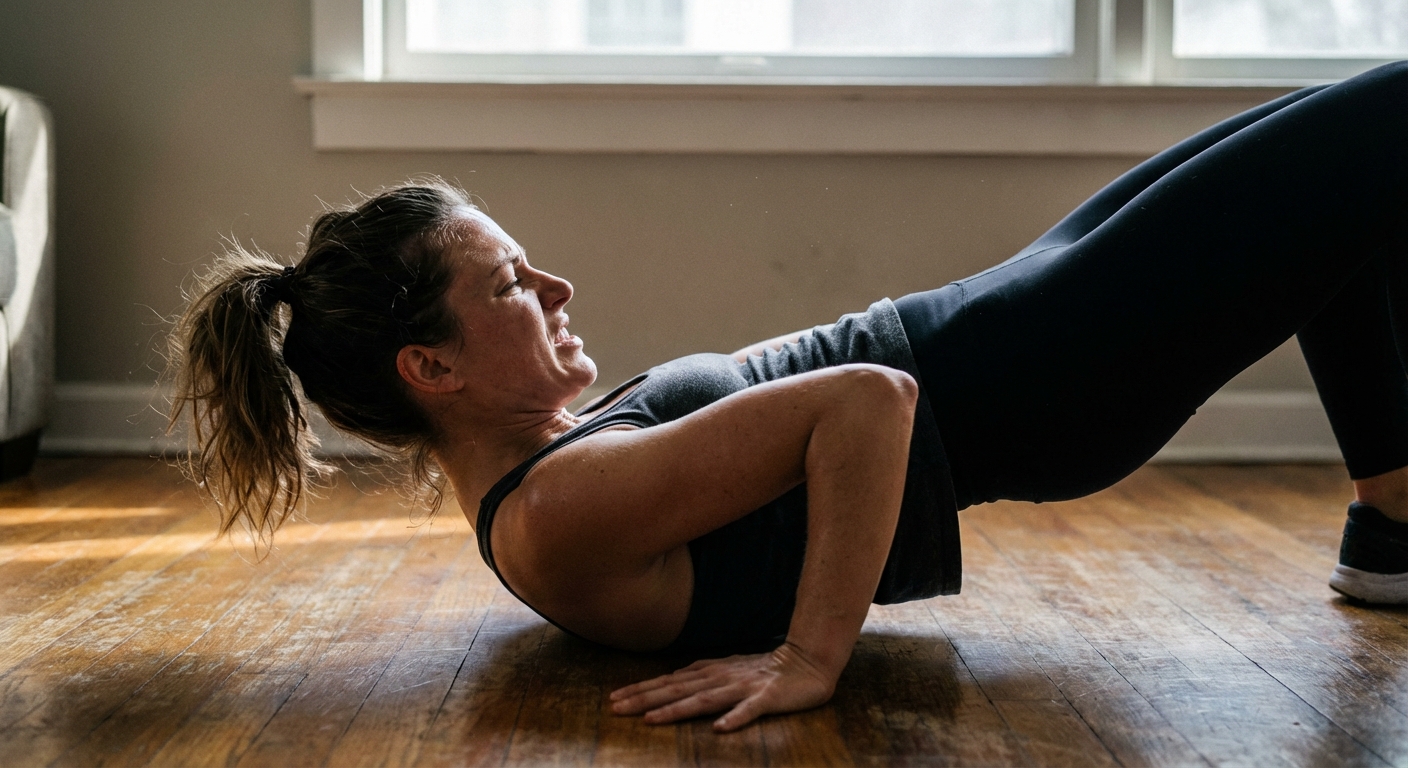
Ready to build serious strength without the joint stress? Glute bridges are your foundation move—they're the ultimate multi-tasker, firing up your back muscles, abs, glutes, and hamstrings while giving those hip flexors a much-needed stretch [9]. Here's how to nail the double-leg variation: lie on your back with knees bent at 90 degrees, engage that core like you mean it, then drive through your glutes (not your back! ) to lift those hips [9]. Keep your spine neutral by maintaining core engagement—this is where the magic happens for building real, functional strength. Once you've mastered the basics, it's time to level up with marching glute bridges.
This variation brings the challenge while keeping your joints happy. From your elevated bridge position, lift one foot off the ground—here's the key: keep those hips dead level, like you're balancing a tray on your pelvis [10]. This move seriously challenges your supporting leg and core, building the single-leg strength that powers you through every step, stride, and sprint in daily life [10]. Pro tip: press those elbows into the floor for rock-solid stability, and if your hips start to dip, correct that form before lowering your leg [9]. Here's your progression roadmap to get stronger every damn day: master double-leg bridges first, then level up to offset bridges (one foot slightly farther away), marching bridges, and eventually the beast mode single-leg variation [9]. Each step ups the challenge while keeping things joint-friendly—exactly what we're after.
Aim for 10-15 quality reps of whatever variation challenges you right now [9]. Runners, take note: marching bridges are your secret weapon for powerful hip extension and rock-solid pelvic stability [10]. Hamstrings cramping? No worries—just bring those feet closer to your glutes and take a quick stretch break [9].
Standing Hip Abduction Series
Standing hip abduction is about to become your new favorite move for bulletproof hips. This exercise targets those often-forgotten muscles on the outside of your hips—the ones that keep you stable and strong through every step of your day [13]. Set yourself up for success: loop a resistance band around one ankle, then step on it with your opposite foot—want more burn? Step closer to the loop [13].
Stand tall and proud with those abs engaged, resisting any temptation to lean [13]. Now for the money move: slowly sweep your banded leg straight out to the side, keeping toes pointing forward, then bring it back with total control [11]. Feel that burn on the outside of your hip? That's exactly where you want it—not in the front of your thigh [11].
Hit 3 sets of 10-15 reps per side, and don't be shy about using a wall or chair for balance support [11]. This move is a game-changer if traditional squats and lunges leave you hurting [11]. Mix it up with the standing clamshell variation—bend that knee slightly and rotate outward, keeping the movement small but mighty for maximum muscle engagement [11]. Stay devoted to these hip-strengthening moves and watch those everyday aches disappear while you build the kind of functional strength that makes life easier [12].
Wall Sit & Calf Raise Combo
Talk about bang for your buck—this wall sit calf raise combo lights up your entire lower body without hammering your joints. Here's your setup: back flat against the wall, feet about two feet out and shoulder-width apart, then slide down until your thighs are parallel to the floor with that core locked in tight [14]. Now add the magic: press through your toes to rise up onto the balls of your feet, hold for a beat at the top, then lower back down—all while maintaining that wall sit [14]. You're hitting quads, hamstrings, adductors, hip flexors, calves, and core in one killer move [15]. The secret sauce? Keep those calf raises slow and controlled—this forces your muscles to do all the work without relying on your Achilles tendon [14].
Press that back firmly against the wall throughout (no cheating! ) to protect your spine and lock in perfect form [14]. Start strong with 8-10 calf raises during a 15-30 second wall sit, then build up both time and reps as you get stronger [15]. This isn't just about muscle—you're building endurance, upgrading your posture through those stabilizer muscles, and developing the kind of balance that keeps you solid on your feet [15]. Here's something that'll fire you up: research in the British Journal of Sports Medicine shows isometric exercises like wall sits crush it for lowering blood pressure—even better than HIIT, aerobics, or regular strength training [15]. So you're not just building strength, you're taking care of your heart too.
Ready to level up? Try single-leg calf raises during your wall sit by extending one leg forward while the other does all the work [14]. Want more burn? Grab some light weights or slow those movements way down for serious time under tension (we'll dive deeper into this technique in the progression section) [15]. Knees feeling sensitive? No problem—just adjust your wall sit depth to where you feel strong without pain [15].
Progression & Strength Building
Loop a resistance band above your knees during glute bridges and wall sits to instantly activate your hip abductors and build knee-saving stability with every controlled rep.
Adding Resistance Bands
Ready to level up your joint-friendly routine? Resistance bands are your perfect training partner—they add challenge without impact, creating resistance that builds throughout each movement, right where your muscles are strongest [16]. Think of them as your personal strength coach, always providing the perfect amount of tension. Start by looping bands just above your knees during those glute bridges you've mastered. This simple addition fires up your hip abductors while keeping everything aligned—you'll feel those side glutes working overtime to keep your knees from caving in [17].
The beauty is in the instant feedback: if your form slips, you'll know immediately because the tension changes. Choosing the right band is key to your success. Begin with a resistance level that challenges you while still allowing smooth, complete movements [16]. Traditional latex bands typically follow a color system (yellow for light, green for medium, blue for heavy), while fabric bands offer extra durability with slightly less stretch [17]. Take your wall sits to the next level by placing a band above your knees and pressing outward—suddenly every muscle from hips to calves is working together [16].
For standing hip abductions, secure one end under your stable foot and loop the other around your moving ankle. Here's a pro tip: stepping closer to the loop instantly increases the challenge [17]. This targeted approach strengthens the often-forgotten gluteus medius—your secret weapon for knee stability during everything from morning walks to weekend adventures [16]. The best part? Every rep builds functional strength that translates directly to real life, making every movement feel easier and more powerful [16].
Increasing Time Under TensionHere's a game-changing truth: you don't need heavier weights to build serious strength. Time under tension is your secret weapon for maximizing muscle development while keeping things joint-friendly. By simply slowing down your movements, you transform every rep into a strength-building powerhouse.
Let's put this into action with exercises you already know. During glute bridges, take a full 2-3 seconds to lower down, then squeeze and hold for 2 seconds at the top before your next rep [19]. Feel that burn? That's your muscles working harder without any extra equipment. Your glutes will thank you for this focused attention [19].
Transform your wall sits by adding super-slow calf raises—this combination challenges your entire lower body while keeping you stable and protected [18]. For standing hip abductions, count to 3 as you lift your leg out, then another 3 as you return. No more rushing through reps—this controlled tempo forces your muscles to work independently, building true strength around those precious joints [20]. This approach is especially powerful if you're managing joint sensitivities or getting back into fitness after time off. You're building real, functional strength with minimal stress on your body [18].
Ready for more? Add strategic pauses at the toughest points—like holding at the bottom of your wall sit or keeping that leg extended during hip work. These pauses recruit deep stabilizing muscles that protect your joints during daily life [19].
Integrating Balance ChallengesReady to take your stability to the next level? Balance challenges are where the magic happens—transforming basic exercises into powerful movements that build real-world strength and protect your joints for life [16].
Start where you're comfortable. Take those calf raises you've been crushing and try them on one foot. Hold that top position for 3-5 seconds and feel every muscle from ankle to hip working together to keep you steady [16]. This isn't just about balance—you're building the ankle and knee stability that keeps you moving confidently through life. Here's a fun challenge: during your wall sits, try closing your eyes for 5-10 seconds. Suddenly, your body has to work overtime to maintain position without visual cues.
It's amazing how this simple tweak fires up muscles you didn't even know you had [16]. For standing hip abductions, hold that leg extended for an extra beat—your core and hip stabilizers will light up as they work to keep everything aligned [20]. Safety first, always. Start near a wall or sturdy chair—think of it as your training partner, there when you need it but encouraging you to fly solo when you're ready [21]. And here's the truth: wobbling isn't failing, it's learning. Every wobble tells you exactly where to focus your strength-building efforts [16].
Level up by elevating one foot during glute bridges or adding arm movements to standing exercises. These variations shift your center of gravity, challenging your body in new ways [21]. Remember, balance is a skill that improves with practice—research shows you'll see real improvements in 6-8 weeks with consistent training [20]. Best of all? Every minute you spend on balance work translates directly to better movement in daily life and seriously reduces your risk of falls [16]. Keep pushing forward—your future self will thank you for building this foundation of strength and stability!
Recovery & Consistency Practices
After crushing your workout, spend five minutes flowing through these targeted stretches and mindful breathing to flip your body into rest-and-repair mode and wake up pain-free tomorrow.
Cool‑Down Stretch Sequence
Your muscles just crushed that workout—now it's time to show them some love! A dedicated cool-down helps your body transition from work mode to recovery mode, flushing out metabolic waste while bringing your heart rate back to baseline [22]. Start with the hamstring stretch that'll have your legs thanking you tomorrow. Sit with one leg extended and the other bent, foot against your inner thigh. Reach toward your extended foot keeping your back straight—no slouching! Hold for 20-30 seconds, breathing deeply, then switch sides [22]. Next up: the quad stretch your thighs are craving. Stand tall, bend one knee to bring your heel toward your glutes, and gently pull your ankle.
You'll feel that sweet release along your front thigh [22]. Need support? No shame in using a wall—we're here for progress, not perfection. Got tight calves? Let's fix that. Place your hands on a wall, step one foot back keeping it straight, and press your hips forward. Feel that stretch? That's your calves releasing all that hard work [22].
Now for the game-changer—the hip flexor stretch. This move is your secret weapon against lower back pain and poor posture [22]. Kneel on one knee with your other foot forward at 90 degrees, then push your hips forward while keeping your back straight. Your future self will thank you for this one. Finish strong with Child's Pose, the ultimate recovery position. From hands and knees, sit back onto your heels while extending your arms forward [22]. This total-body stretch hits your back, hips, thighs, and ankles while melting away tension. Hold each stretch for 20-30 seconds, breathing deeply and listening to your body—stretching should feel good, never painful [23].
Mindful Breathing for Recovery
Ready to supercharge your recovery? Mindful breathing is your secret weapon, switching on your body's rest-and-repair mode faster than you can say "leg day" [24]. Think of it as a bridge between crushing your workout and crushing your recovery—it clears out metabolic waste while bringing those stress levels way down [26]. Let's start with the foundation: diaphragmatic breathing. Place one hand on your belly and breathe in through your nose, letting your abdomen expand like a balloon. Your chest? Keep it still. This power move delivers premium oxygen to your muscles while boosting blood flow and clearing out toxins [24][26].
Want to level up? Try cyclic sighing—it's like a reset button for your nervous system. Take a normal breath, sneak in a second short inhale to top off your lungs, then let it all out with a satisfying sigh [24]. Science backs this up—research shows this technique beats other breathing patterns for reducing stress and boosting mood [24]. Evening workout warrior? The 4-7-8 technique is your best friend. Inhale for 4 counts, hold for 7, then exhale for 8. This pattern drops your blood pressure and heart rate, setting you up for epic overnight muscle repair [24].
Here's a pro tip: while you breathe, scan your body like you're doing a system check. Find those tight spots in your worked muscles? Use each exhale to consciously release that tension [25]. For the ultimate recovery breath, fill your belly first, then your ribs, then your chest—imagine filling a glass from bottom to top [25]. Even just 2-3 minutes of this focused breathing right after your stretches kickstarts recovery like nothing else [24]. Make it a habit and you'll sleep better, recover faster, and might even ease chronic pain—all crucial for keeping you strong and ready for your next workout [26].
Tracking Workouts for Earned Strength
Here's the truth: tracking your workouts is like having a personal strength GPS.
When you document every low-impact leg session, you're creating proof of your progress that goes way beyond how you feel on any given day [27].
Dynamic marching and hip circles warm joints while boosting workout performance up to 79%.
Glute bridges progress from double-leg to single-leg for joint-friendly posterior-chain strength.
Resistance-band hip abductions target gluteus medius to stabilize knees and erase aches.
Slow 2–3-second eccentrics and pauses build muscle without loading sensitive joints.
Wall-sit calf raises combine isometric quad work with slow calf raises to cut blood pressure.
Post-workout diaphragmatic breathing accelerates recovery by flushing metabolic waste.
Close-eye or single-leg balance drills ingrain ankle/knee stability in 6–8 weeks.