


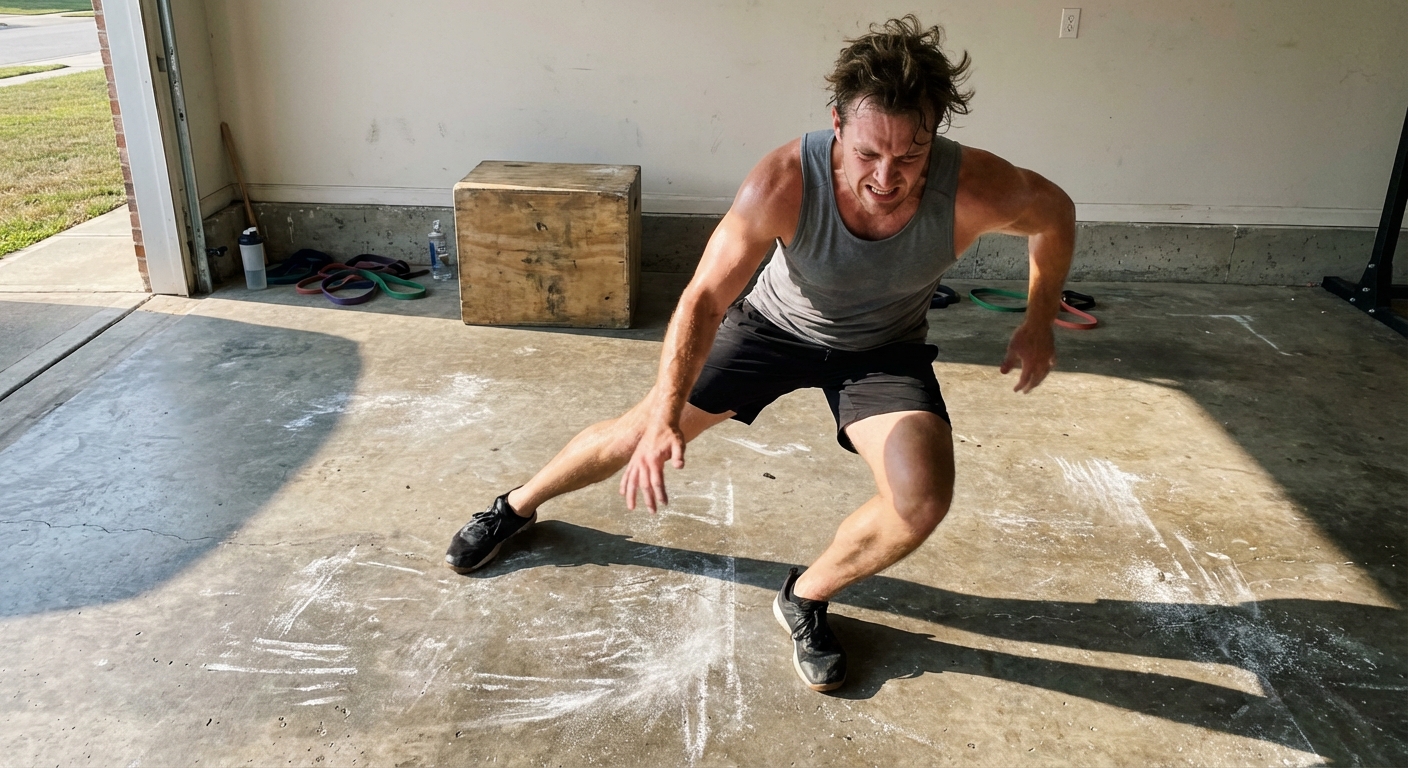
Transform any living room, backyard, or garage into a joint-friendly power lab by laying down 20 mm rubber tiles or foam mats that slash landing forces up to 70 %, clearing an 8×8-foot zone with grippy footing, then priming your hips, ankles, and core through a 5-minute dynamic warm-up of leg swings, inchworms, and light skater hops before you even think about jumping. The article delivers a pro-grade blueprint for explosive legs: master low-rep, high-intensity jump squats, plyo lunges, lateral bounds, and skater hops with ninja-soft landings, track foot contacts (80–140 per session), schedule two to three 20-minute plyo days spaced 48–96 h apart, and layer strength, mobility, and collagen-boosting post-workout stretches so tendons grow stronger while vertical and broad-jump numbers steadily climb. You’ll learn why minimal shoes trump cushioned ones, how a 20 g protein + 50 g carb recovery shake plus 5 g creatine monohydrate accelerates tissue repair and power output, and why elite athletes favor quality over quantity—3–5 all-out reps per set, never rushing—so you build agile, injury-resistant legs that translate to faster cuts on the court, lighter hikes, and everyday athleticism without ever leaving home.
Getting Started: Foundations for a Plyometric Leg Workout at Home
Transform any 8×8-foot patch of rubber flooring, foam tiles, or grass into a joint-saving launchpad that cuts impact forces up to 70%—then fire up your hips and hamstrings with arm circles, leg swings, and walking lunges so you can explode into plyos without injury.
Assessing Your Space and Safety
Ready to transform your living space into a power-building gym? Let's make sure you're set up for success! Your training environment is just as important as the exercises themselves. Hard surfaces like concrete are your joints' worst enemy - they significantly increase injury risk and should be avoided [1]. Instead, create your own performance zone with shock-absorbing surfaces that have your back (and knees!
). Think rubber flooring (at least 20mm thick), interlocking foam tiles (20-40mm), or specialized exercise mats [3]. These surfaces can reduce impact forces by 30-70% compared to concrete - that's the difference between training strong and training smart [3]. You'll need enough room to move freely - aim for at least 8×8 feet of clear space for basic jumping exercises, with extra room for those explosive lateral movements [2]. Check your ceiling height too - you want to jump without worry!
And here's a crucial detail: your floor needs good traction. Slippery surfaces are a recipe for disaster during explosive movements [1]. If your indoor space feels cramped, don't let that stop you - take it outside! A grassy area in your backyard can be the perfect natural training surface. Remember, the devoted find a way to train anywhere - it's about making the most of what you've got.
Essential Warm‑Up Moves to Prime Your Muscles
Time to fire up that explosive power! A dynamic warm-up isn't just a suggestion - it's your secret weapon for crushing your plyometric workout. These movements gradually wake up your muscles, boost blood flow, and prep your joints for the high-impact action ahead [4]. Think of it as turning on your body's performance mode. Start with the basics and build your intensity - this isn't the time to go all-out. Kick things off with arm circles and leg swings to get those shoulders, hips, and hamstrings moving freely [6].
Next, level up with walking lunges paired with torso rotations - this combo activates your hip muscles and improves the mobility you need for powerful jumping mechanics [4]. Ready to turn up the heat? Add inchworms with push-ups to engage your core and boost lower body flexibility [4]. Then get that heart pumping with high knees and butt kicks - your quads, hamstrings, and hip flexors will thank you later [4]. Don't forget lateral movement prep! Side shuffles and light lateral bounds wake up those glutes and prepare your body to move in all directions [6].
Cap it off with some easy squat jumps or skater hops at moderate intensity - just enough to activate your nervous system without wearing yourself out [5]. In 5-10 minutes, you should feel warm, slightly sweaty, with your heart rate up - that's your body saying "let's do this! " [6]. Trust the process - this warm-up is setting you up for your strongest performance yet.
Choosing Footwear and Minimal Equipment
Here's something that might surprise you - those ultra-cushioned shoes aren't doing you any favors for plyometric training. Your feet and ankles need to work, not hide behind thick midsoles! During controlled plyometric training, you actually want your muscles and tendons absorbing those forces and getting stronger - not your shoes doing all the work [7]. Go for flexible, lightweight footwear with just enough support to let your feet move naturally.
Think minimal but protective - options that are 30% lighter than average cross-trainers work best, giving you better leverage during explosive movements [7]. Your feet are part of your strength foundation, so let them do their job! Now for the gear that'll take your home workouts to the next level - and no, you don't need to break the bank. Start with the essentials: a sturdy plyobox is your Swiss Army knife for jumping variations (a stable bench or solid chair works too when you're starting out) [8].
Want to add some variety? Adjustable hurdles that collapse on contact are perfect for safe lateral work at home [8]. A quality jump rope is your coordination secret weapon - just make sure it's the right length for your height with comfortable handles [8]. If you've got the space, banana steps (those 6-24" platforms) are game-changers for teaching perfect landing mechanics while building progressive jumping power [8].
Core Plyometric Moves to Build Explosive Power
Master jump squats, plyo lunges, and skater hops with soft ninja landings and perfect knee tracking to ignite every lower-body muscle and turn your legs into explosive, cardio-crushing engines of power.
Jump Squats and Plyo Lunges for Quad Blast
Ready to unleash your inner athlete? Jump squats and plyometric lunges are your ticket to building serious lower body power. Start your plyo lunges in a split stance, both knees at 90 degrees, then explode upward and switch legs mid-flight [9].
These dynamic moves fire up your quads, glutes, hamstrings, and calves all at once [9]. The key to nailing these exercises? Keep your chest proud, land soft like a ninja, and make sure those knees track straight over your toes [9].
Don't chase height at first – quality beats quantity every time. Once you've mastered the basics, level up with lateral variations, add some torso twists, or grab light dumbbells for an extra challenge [9]. Here's the bonus: these power moves double as cardio crushers, sending your heart rate through the roof while building strength [9].
Lateral Bounds and Skater Hops for Agility
Time to channel your inner athlete with lateral bounds and skater hops – the secret weapons for lightning-fast agility. Picture yourself as a speed skater: from your athletic stance, push off explosively to one side, land on a single leg, then bound immediately in the opposite direction [10]. Your landing is everything here – think soft, controlled, and powerful. Keep those knees tracking straight, chest tall and proud, and core locked in tight [12].
These side-to-side powerhouses light up your outer thighs, calves, and inner thighs while building the balance and stability you need for quick cuts and directional changes [11]. Start strong with just five bounds per leg, focusing on perfect form over speed. Rest for 60-90 seconds between sets – this isn't about exhaustion, it's about explosive power [11][12]. Watch out for the rookie mistakes that can sideline your progress: rushing through reps, landing with stiff legs or knees caving inward, and skipping your warm-up [10].
Once you own the movement, challenge yourself by increasing jump distance, adding more reps, or incorporating plyo boxes [11]. Whether you're crushing it on the basketball court, dominating the tennis court, or just want to move like an elite athlete in everyday life, these exercises are your game-changers [12].
Progression and Programming for Your Plyometric Leg Workout at Home
Train like the pros by scheduling just 2-3 quality plyo sessions weekly—3–5 all-out reps, 80–140 foot contacts, and 48–96 h recovery—to spark explosive power without burnout.
Designing a Weekly Schedule for Strength and Recovery
Ready to build explosive power like the athletes who inspire us? Your plyometric journey starts with smart scheduling that respects your body's need for recovery. Since these explosive movements train your nervous system more than building muscle size, you'll need 48-96 hours between sessions to fully recharge [13][14]. That's why we recommend 2-3 weekly sessions max—quality beats quantity every time [14]. For those crushing depth jumps or weighted plyometrics, dial it back to twice weekly with at least 48-72 hours between sessions [13][14]. Your ideal workout structure?
Keep it simple: 15 minutes getting warm, 20-30 minutes of explosive work, and 15 minutes cooling down [13]. Remember, less is more here—just 3-6 sets of 2-5 reps per exercise delivers incredible results without burning out [15]. Mix it up strategically! On strength days, add some lighter plyos for activation. Save your high-intensity jump sessions for separate days when you're fresh and ready to give it everything. New to this?
Start with a 4-6 week program to nail the basics and build those neural pathways. Already crushing it? Extend to 12-18 weeks with smart progression [13]. This approach—inspired by elite training methods—maximizes your power gains while keeping you injury-free and ready for more.
Scaling Intensity: Reps, Sets, and Rest Intervals
Here's the secret elite athletes know: explosive power comes from focused, quality reps—not endless jumping. Stick to 2-4 sets of just 3-5 reps per exercise, giving each rep your absolute maximum effort [16]. This isn't about exhaustion; it's about training your nervous system to fire faster and stronger.
Want to track progress like a pro? Count your foot contacts (every landing = one rep). If you're starting out, keep it to 80-100 contacts per session.
Intermediate? Aim for 100-120. Advanced athletes can handle 120-140 [17].
Integrating Strength and Mobility for Long‑Term Gains
Want to unlock your full explosive potential? Think beyond just jumping—true power comes from combining plyometrics with smart strength work and mobility training. Without a solid strength foundation, your body can't handle the forces that create real power [18]. That strength isn't just about lifting heavy; it's your armor against injury and your launchpad for explosive movement. Here's what's happening beneath the surface: every jump triggers your body to build stronger connective tissues. Your tendons, ligaments, and cartilage respond to this controlled stress by producing more collagen, creating a bulletproof support system around your joints [20].
It's your body's way of saying "I've got this" to whatever challenge comes next. Don't forget mobility—tight hips, stiff ankles, or a locked-up back will sabotage your best efforts [19]. Think of mobility work as unlocking your body's full range of power. When everything moves freely, every jump becomes more explosive. Smart programming brings it all together. Hit heavy squats on Monday?
Save your jump training for Wednesday or Thursday, giving your nervous system time to recover while keeping those movement patterns fresh [18]. This isn't about working harder—it's about working smarter, inspired by the same principles that keep elite athletes performing at their peak [18]. Track your wins with simple tests like vertical jump height or broad jump distance [19]. These numbers tell the real story of your progress, keeping you motivated and focused on what matters: becoming more explosive with every session.
Recovery, Nutrition, and Mindset for Sustainable Strength
Stretch, fuel, and focus: seize the 30-60 minute post-plyo window with 20-40 g protein, targeted mobility, and deliberate soft-land drills to turn today’s jumps into tomorrow’s bulletproof power.
Post‑Workout Stretching and Mobility Routines
You've just crushed your plyometric workout—now it's time to show your body some love. The minutes after explosive training are golden for recovery, and smart stretching makes all the difference between feeling strong tomorrow versus sore for days. Start with gentle dynamic movements to keep blood flowing, then transition into deeper stretches that target the muscles that worked hardest: your calves, quads, hamstrings, and hip flexors [21]. Think of post-workout mobility as strength maintenance. Those targeted stretches don't just feel good—they actively maintain tissue elasticity and prep you for your next power session.
Your ankles deserve special attention since restricted ankle mobility often sabotages landing mechanics [23]. This is your time to sink into those 30-45 second holds you avoided during warm-up, addressing any tightness that built up during training. Here's what makes this recovery work so powerful: it actually strengthens your connective tissues. Research shows that proper post-workout stretching stimulates collagen production, building stronger tendons and ligaments around your joints [23]. Try slow, controlled movements that mirror your jumping patterns minus the explosion—think deep bodyweight squats or walking lunges.
This reinforces perfect form while helping flush metabolic waste from your muscles [23]. For an advanced recovery technique that builds resilience, add some light bounding with laser focus on soft landings after tough sessions [22]. When you're fatigued, your body wants to get sloppy—but training proper form when tired teaches your nervous system to maintain technique even under stress. This simple practice significantly reduces injury risk and keeps you training consistently. Ready to take your recovery game to the next level?
Fueling Muscles for Explosive Growth
Your muscles are primed for growth in that crucial window after training—let's fuel them right. Within 30-60 minutes of your last jump, aim for a powerful combo: 20-40 grams of protein paired with 50 grams of carbs [25]. This dynamic duo works harder together than alone, shutting down muscle breakdown while firing up repair and growth [25]. Here's the game-changer many athletes miss: your body can't store protein like it stores carbs and fat. That means consistent fueling throughout the day matters just as much as your post-workout shake. Target 20-40 grams of protein at each meal to keep those strength and power gains coming [25].
Want to supercharge your explosive power? Add 5 grams of creatine monohydrate to your daily routine. This well-researched supplement directly feeds your ATP-PC energy system—the exact system powering those explosive jumps and bounds [25]. Studies consistently show creatine boosts strength, builds muscle mass, and cranks up high-intensity performance [25]. Remember, undereating sabotages your gains. When you're not meeting your energy needs, your body can't effectively use protein for muscle repair—it gets diverted to basic energy instead [25].
For explosive training, carbs should make up about 55-60% of your daily intake (that's 3-5g per kg of body weight), keeping your glycogen stores fully loaded for maximum power output [24]. The bottom line? Nail your nutrition timing and watch your recovery accelerate. Those fast-digesting carbs and proteins you consume right after training kickstart glycogen replenishment and muscle repair when your body needs it most [24]. Feed your strength journey with the same dedication you bring to your training, and those explosive gains will follow.
Use 20-40 mm foam or rubber flooring to cut impact forces 30-70% vs concrete.
Limit plyo to 2–3 sessions/week, 48-96 h apart, 3-5 max-effort reps per set.
Count landings: 80-100 contacts beginner, 100-120 intermediate, 120-140 advanced.
Post-workout, eat 20-40 g protein + 50 g carbs within 30-60 min for repair.
Lightweight, flexible shoes 30% lighter than cross-trainers boost jump leverage.
Combine plyos with strength and mobility; schedule jumps 48-72 h after heavy squats.
Finish with 30-45 s stretches and light bounding on tired legs to lock in safe landings.